The Cost of Choosing the Wrong Supplier
Choosing a packaging supplier is one of the highest-stakes decisions a jewelry brand makes — and one of the most underestimated. A poor choice leads to wasted samples, delayed product launches, inconsistent quality, and packaging that undermines your brand rather than elevating it.
This guide is not about choosing between box styles or materials — our guide to choosing premium packaging covers that. This is about evaluating the company behind the packaging: how to tell a reliable, quality-focused partner from one that will cost you time, money, and brand credibility.
What Makes Jewelry Packaging Different
Jewelry packaging is not general packaging. It demands precision tolerances measured in millimeters — a ring insert that is a fraction too large lets the ring shift and scratch. It requires premium material handling: genuine leather, velvet and suede, silk interiors that show every imperfection.
It calls for specialized finishing techniques — embossing, foil stamping, debossing — executed on surfaces where even minor misalignment is visible. And it requires small-batch flexibility, because most jewelry brands do not order packaging in the tens of thousands.
A general packaging supplier may produce excellent corrugated shipping boxes but lack the tooling, material sourcing, or craftsmanship expertise for luxury jewelry. The evaluation criteria below are specific to what jewelry packaging demands.
7 Criteria for Evaluating a Supplier
1. Material Sourcing and Quality Control
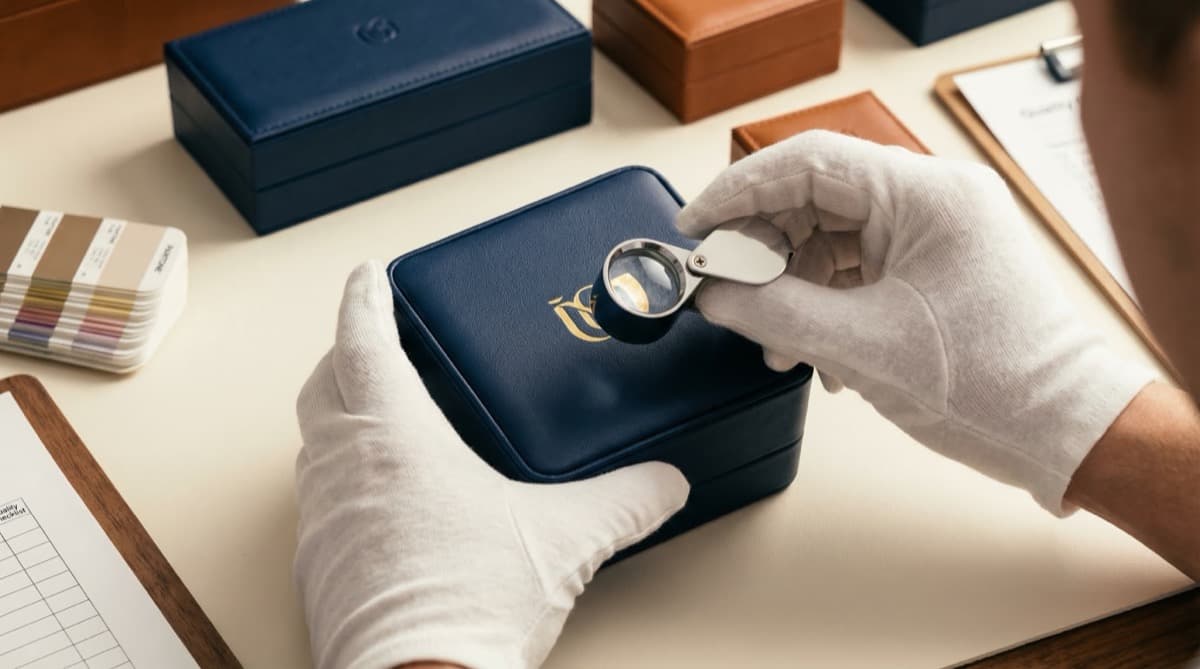
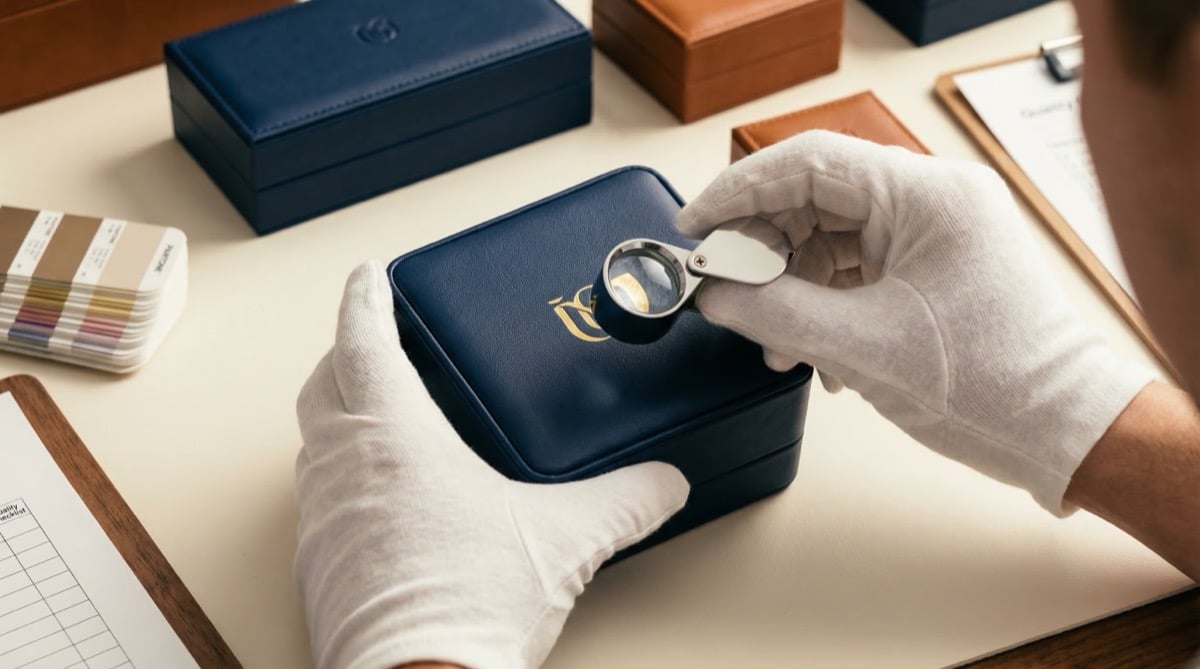
Can the supplier source the materials your brand needs? Genuine leather, premium velvet, suede, custom-dyed fabrics? Ask to see material swatches and any relevant certifications (FSC for paper, origin documentation for leather).
Look for incoming material inspection standards. A quality supplier checks materials before they enter production — not just after products are finished. Ask about their AQL (Acceptable Quality Level) sampling standards.
2. Customization Capabilities
Understand the difference between full custom, semi-custom, and stock with logo.
- Full custom: Your design from scratch — unique dimensions, materials, colors, inserts, and branding. Requires higher MOQ (typically 300–1,000+).
- Semi-custom: Existing box structure with your choice of material, color, and logo. Lower MOQ, faster turnaround.
- Stock with logo: Pre-made boxes from the supplier's catalog with your logo added. Lowest MOQ, least differentiation.
Ask specifically about logo techniques: embossing, foil stamping, debossing, embroidery, screen printing, laser engraving. A serious jewelry packaging supplier should offer at least four of these. Also confirm Pantone color matching capability — your brand colors should be exact, not approximate.
3. Sampling Process and Turnaround
A reputable supplier always provides physical samples before production. If a supplier pressures you to skip sampling and go straight to production, that is a warning sign.
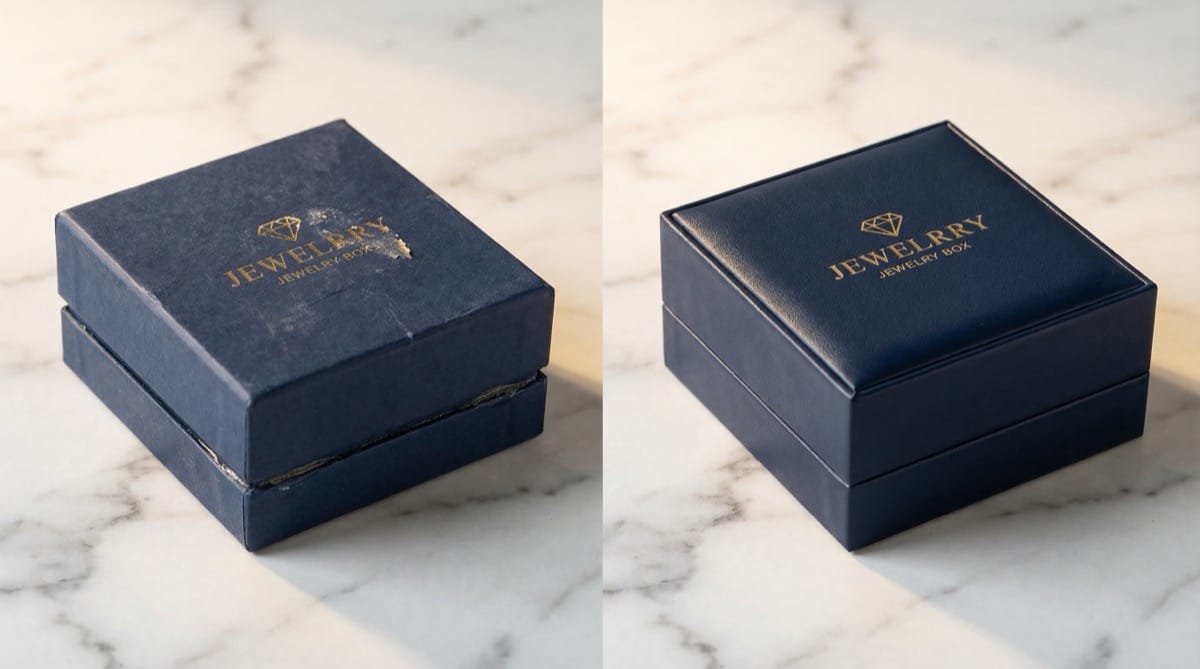
When evaluating a sample, check: material feel and weight, color accuracy against your Pantone reference, logo precision and placement, hinge or closure quality, and interior fit with your actual jewelry piece. Expect 1–3 rounds of sampling to get everything right.
For a step-by-step look at what the sampling and ordering process involves, see our complete ordering guide.
4. MOQ Flexibility and Scalability
Industry MOQ ranges vary widely: 50–100 units for stock items, 300–500 for semi-custom, 1,000+ for fully custom from large overseas factories. Ask about the supplier's range and whether they offer pilot runs for new brands.
Equally important: can the supplier scale with you? A partner who works with you at 300 units should be able to handle 5,000 units when your brand grows — without a quality drop.
Be cautious of very low MOQs on supposedly "fully custom" items. This often means stock items with a logo applied, not true custom packaging.
5. Production Transparency and Timelines
A trustworthy supplier offers clear production milestones: design approval, sampling, pre-production confirmation, production, quality control, and shipping. Realistic timelines for custom jewelry packaging are 4–8 weeks from approved sample to delivery, depending on complexity.
Ask whether they provide progress updates and production photos. Transparency during production is one of the strongest indicators of a reliable partner. Our process page shows what a transparent production timeline looks like.
6. Communication and Responsiveness
Pay attention to how quickly and clearly a supplier responds to your initial inquiry. A 48-hour response time is reasonable; five or more days is a concern.
Other signals to evaluate: Do you have a designated account manager, or are you passed between different contacts? Is there language and timezone compatibility for US or EU business hours? Is the supplier willing to get on a video call or share factory photos and videos?
7. Sustainability and Certifications
Sustainability is no longer optional — over 60% of jewelry brands now require recyclability as a baseline when evaluating suppliers. Ask about FSC certification for papers, eco-friendly alternatives for foam inserts, and water-based adhesives.
Look for ISO 9001 (quality management), BSCI (social compliance), or equivalent certifications. These are not guarantees of quality, but their absence should prompt further questions.
Red Flags When Evaluating Suppliers
These warning signs apply across the industry. If you encounter more than one, proceed with extreme caution:
- No physical samples available — "trust the photos" is not acceptable for premium packaging
- Vague or shifting pricing — no itemized quote, surprise fees after order placement
- Unwilling to sign an NDA — your designs and branding are proprietary
- Unrealistically low MOQ on full-custom items — likely stock items being misrepresented
- No factory photos or video — a legitimate manufacturer is proud of their facility
- Pressure to skip sampling — "the production will look the same" is a red flag
- No clear return or defect policy — what happens when a batch arrives with quality issues?
- Generic email addresses — professional suppliers use branded email domains
- No references or portfolio — if they cannot show past work, proceed with caution
Domestic vs. Overseas Suppliers
When to Choose a Domestic Supplier
Domestic suppliers (US or EU-based) make sense when you need urgent timelines (2–4 week turnaround), are ordering small runs under 500 units, need in-person meetings or factory visits, or are producing packaging for a trade show on a tight deadline.
The tradeoff: higher per-unit cost and often more limited customization options.
When to Choose an Overseas Supplier
Overseas suppliers (typically Asia-based) are strongest for fully custom designs from scratch, volume orders of 300+ units, access to a wider range of materials (genuine leather, exotic fabrics), and significant cost savings at scale — often 15–30% lower per unit.
The tradeoff: longer lead times (6–10 weeks) and the need for disciplined sample approval before production begins.
The Best of Both Worlds
Some suppliers bridge the gap. DDP (Delivered Duty Paid) shipping means the supplier handles all logistics — freight, customs, duties — and delivers to your door with one all-inclusive price. A dedicated account manager who works in your timezone eliminates the communication gap. Virtual factory tours and real-time production updates make distance manageable.
The question is not "domestic or overseas" — it is whether the supplier's capabilities, communication, and quality standards match what your brand needs.
10 Questions to Ask Before Placing Your First Order
Use this checklist in your next supplier conversation:
- What is your minimum order quantity for fully custom packaging?
- Can I see samples of work you have done for other jewelry brands?
- What materials do you specialize in? (Leather, velvet, paper, etc.)
- What is your standard production timeline from approval to delivery?
- How do you handle quality control during production?
- What happens if a batch arrives with defects?
- Do you offer Pantone color matching?
- What logo techniques do you support?
- Can you ship DDP to the US or EU?
- Will I have a dedicated point of contact?
Choosing a packaging supplier is choosing a long-term brand partner. The right supplier does not just fill an order — they invest in understanding your brand, anticipate your needs as you grow, and maintain the quality consistency that your customers expect.
Ready to evaluate your options? Request a sample or get a custom quote to see how we work, or explore our process for a full walkthrough from consultation to delivery.