Why Necklace and Bracelet Packaging Requires a Different Approach
Necklaces and bracelets are the longest, most movement-prone pieces in any jewelry collection — and that makes them the most difficult to package well. A pendant that shifts inside its box arrives tangled. A chain bracelet rattling loose against a hard surface picks up scratches before the customer even opens the lid.
Unlike rings or earrings, which sit neatly in compact enclosures, necklaces and bracelets demand packaging engineered around length, drape, and tension. The box must hold the piece securely without kinking the chain, display the design attractively, and protect delicate links and clasps during transit.
This guide covers packaging formats for both necklaces and bracelets — two categories that share similar challenges around chain management, interior layout, and presentation. We also address materials, branding, and a decision framework to help you choose the right solution for your line. For earring-specific guidance, see our earring packaging guide.
Types of Necklace Packaging
Pendant and Chain Boxes
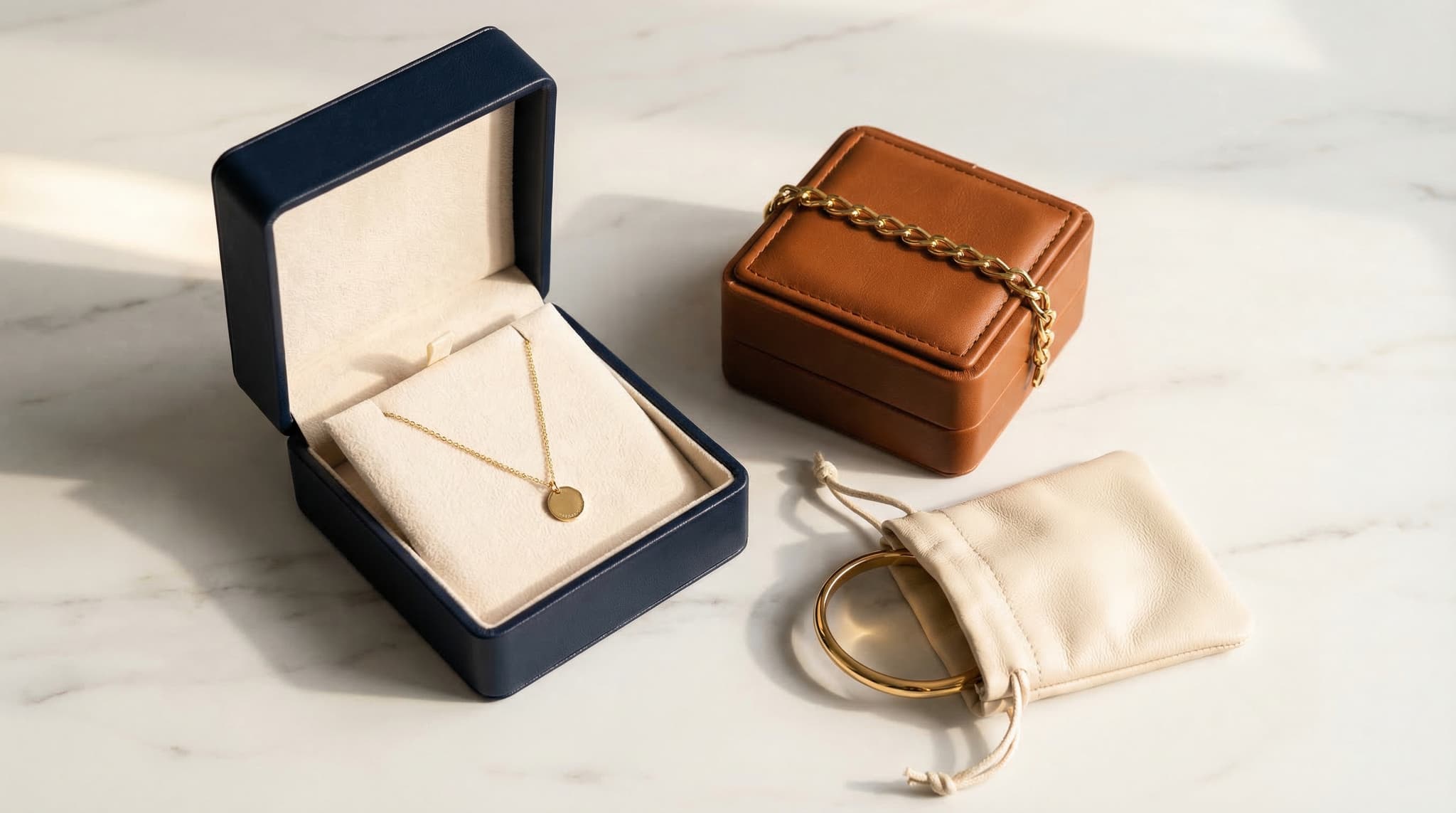
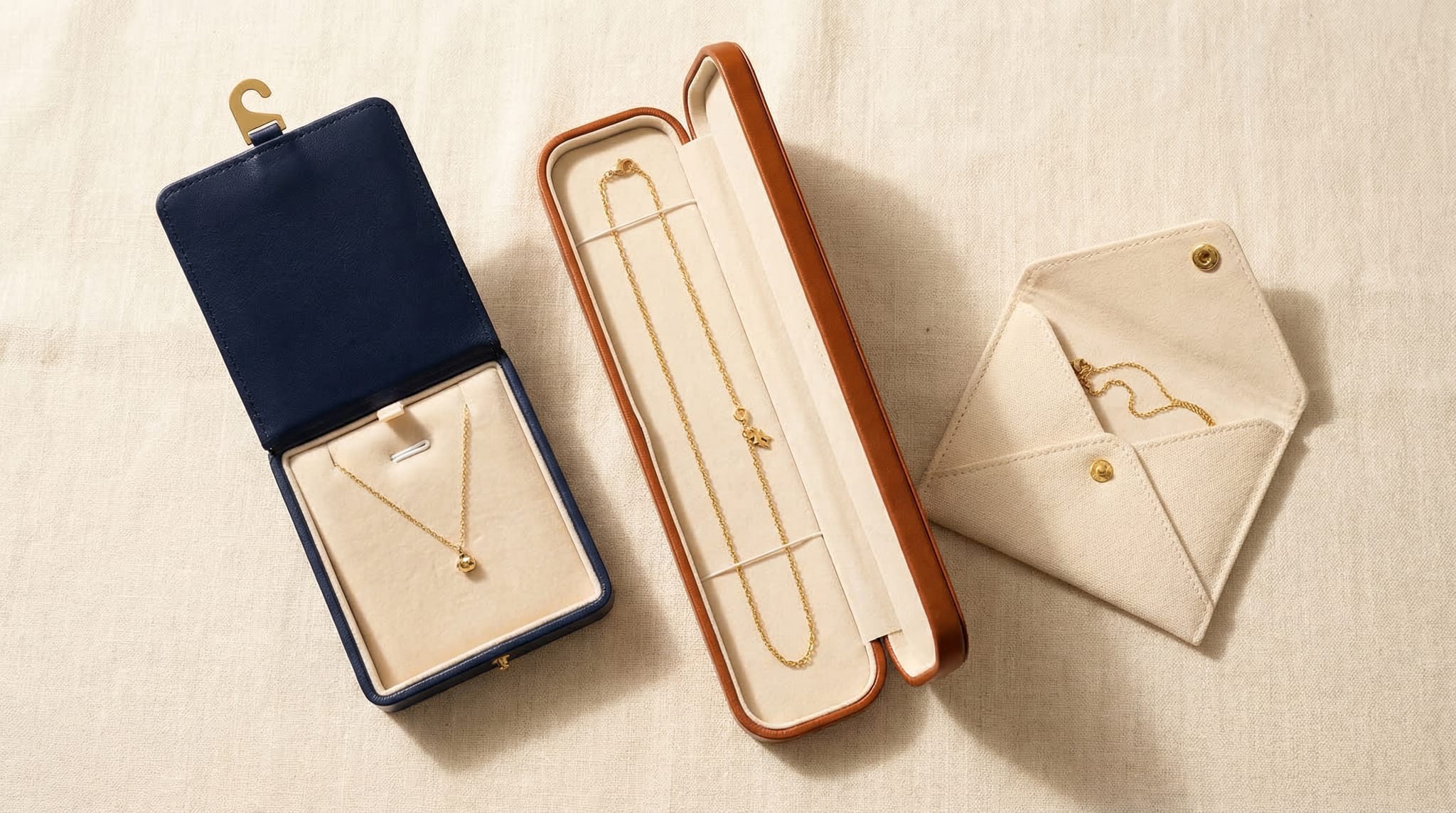
Rigid boxes in rectangular or square formats are the most common necklace packaging. The key is the interior: a hook, slot, or tab at the top of the insert holds the clasp, allowing the chain to drape naturally downward over a padded cushion. This prevents tangling and displays the pendant at center stage.
Size guidance: pendant necklaces on 16–20-inch chains fit well in boxes measuring roughly 170 x 120 mm (6.7 x 4.7 inches). Longer opera-length necklaces or layered sets need 200 mm or taller enclosures. Always size the box to your longest chain length with a small margin — chains should drape, not bunch.
Long Necklace Cases
For statement necklaces, lariats, and multi-strand pieces, elongated hinged cases or roll-style packaging offer the interior real estate these pieces require. Hinged cases open flat to display the full length of the necklace. Rolls use soft fabric to wrap and cushion the piece — ideal for travel-oriented brands.
Necklace Pouches and Envelopes
Leather and fabric pouches in drawstring, snap-closure, or envelope styles offer a softer, more tactile presentation. They work particularly well as secondary packaging inside a box, as travel companions, or as the primary packaging for everyday and fashion jewelry brands focused on e-commerce efficiency.
For delicate chains, pouches with internal fabric dividers or small hook tabs prevent tangling — a detail that separates thoughtful packaging from generic solutions.
Display Cards and Necklace Holders
Necklace display cards — rigid cards with a notch or slit at the top to secure the clasp — are a cost-effective option for fashion jewelry and wholesale. The chain hangs freely on the card, creating an immediate visual of how the necklace wears. Cards can be placed inside boxes or used standalone for retail pegs and displays.
Types of Bracelet Packaging
Bracelet Boxes with Cushion Inserts
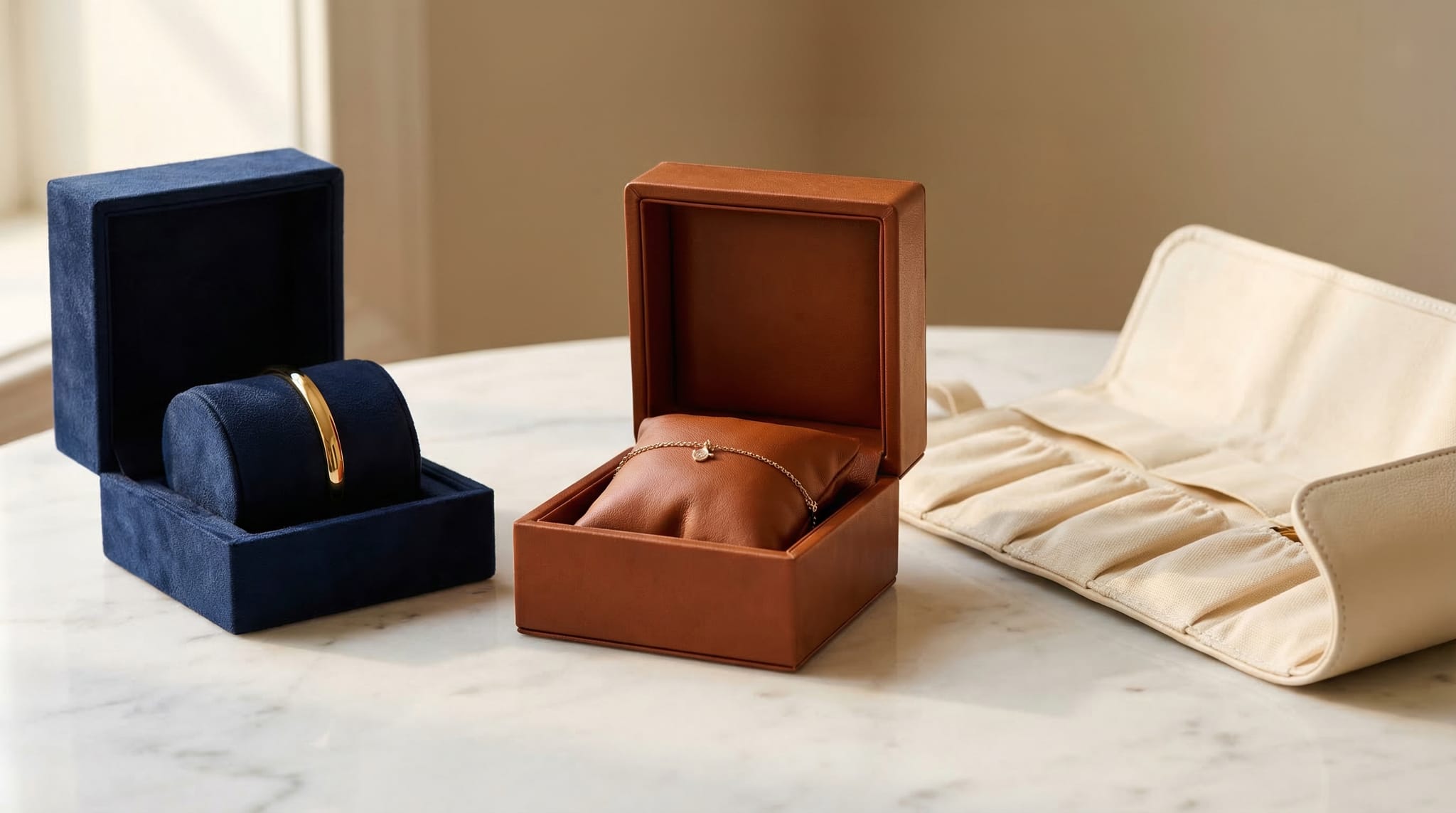
Rigid bracelet boxes typically feature a padded cylindrical cushion or pillow insert. The bracelet wraps around the cushion, mimicking how it sits on a wrist. This is the gold standard for bangles, cuffs, and chain bracelets — it protects the piece and creates an aspirational presentation.
Box dimensions for bracelets generally range from 85 x 85 mm (3.3 x 3.3 inches) for slim bangles to 100 x 100 mm (4 x 4 inches) for wider cuffs. The cushion height should position the bracelet at or just below the box rim for a clean reveal when the lid lifts.
Watch-Style Bracelet Boxes
For wider cuffs, statement bangles, and heavy chain bracelets, watch-style boxes with a hinged lid and padded pillow provide a premium presentation. The wider footprint accommodates larger pieces and the hinged mechanism adds a ceremonial quality to the unboxing.
Bracelet Pouches and Roll Cases
Soft pouches work well for chain bracelets and delicate bangles, especially for travel and casual gifting. Roll cases with individual compartments suit brands selling bracelet stacks or collections — each piece gets its own slot, preventing contact and tangling.
Necklace and Bracelet Packaging Comparison
| Packaging Type | Best For | Protection Level | Brand Impact | Price Range |
|---|---|---|---|---|
| Rigid pendant box with hook insert | Pendant necklaces, chains | High — chain secured, no tangling | Premium — strong shelf and unboxing presence | $$$ |
| Elongated hinged case | Statement and layered necklaces | High — full-length display and protection | Luxury — ceremonial opening | $$$$ |
| Necklace pouch with divider | Everyday chains, e-commerce | Medium — soft protection, tangle-free | Warm and tactile | $$ |
| Display card in box | Fashion necklaces, wholesale | Medium — visual display, needs outer box | Clean, retail-ready | $ |
| Bracelet box with cushion | Bangles, cuffs, chain bracelets | High — wrist-like presentation | Premium — aspirational reveal | $$$ |
| Watch-style hinged box | Wide cuffs, statement bangles | High — padded, ceremonial | Luxury — gift-worthy | $$$$ |
| Bracelet pouch or roll | Stacking sets, travel pieces | Medium — soft, compact | Casual luxury | $$ |
Materials and Interior Design
Exterior materials define the first impression. Genuine leather signals luxury and tactile quality. Leatherette offers a similar look at a lower cost. Velvet and suede wrapping adds richness without weight. Premium paperboard with soft-touch or linen finishes works well for mid-market positioning.
Interior linings must balance aesthetics with function. Velvet is the most popular choice for necklace and bracelet boxes — it cushions, prevents scratches, and photographs beautifully. Suede offers a more contemporary matte feel. Satin creates a luminous backdrop that makes gold and gemstones glow.
Chain management details separate good necklace packaging from great necklace packaging. These include:
- Hook tabs or slots at the top of the insert to secure the clasp
- Tension channels — shallow grooves in the insert that guide the chain into a controlled drape
- Soft-grip pads that hold chain links without crimping
- Removable cushions that let the customer lift the entire necklace out cleanly
For bracelets, the cushion insert is the most critical element. It should be firm enough to hold its shape but soft enough to not scratch the bracelet interior. Flocked foam (velvet or suede finished) is the standard.
Anti-tarnish protection matters for sterling silver, plated metals, and copper alloys. Acid-free tissue wraps, anti-tarnish strips, and treated interior linings extend the shelf life of your jewelry and reduce customer returns from tarnish complaints.
Branding Your Necklace and Bracelet Packaging
Necklace and bracelet boxes offer generous surface area for branding — more than ring or earring boxes, simply because they are larger. This is an opportunity to make a statement.
Exterior branding options include embossed or debossed logos, hot foil stamping in gold or custom Pantone colors, screen printing, and laser engraving on leather or wood surfaces. For necklace boxes, the lid is the primary branding canvas. For bracelet boxes, both the lid and the interior base (visible when the cushion is removed) can carry branding.
Interior branding adds surprise: a printed message on the lid lining, a branded ribbon pull for lifting the cushion, or a custom-color insert that reinforces your palette. These details photograph well and drive social sharing — particularly valuable for brands whose customers post unboxing content.
Suite consistency is essential. If your brand also sells earrings and rings, your necklace and bracelet packaging should share the same material, color, and logo placement language across the full range. A cohesive packaging family is a powerful brand signal. See our earring packaging guide for the companion approach.
How to Choose the Right Packaging
Five factors should drive your decision:
-
Jewelry type and dimensions — a 16-inch pendant chain requires different packaging than a 30-inch lariat or a rigid bangle. Measure your pieces and spec the interior insert first, then design the box around it.
-
Price point alignment — the packaging should feel proportional to the jewelry's value. A $1,200 gold necklace warrants genuine leather and velvet. A $60 fashion bracelet pairs well with a branded pouch or leatherette box.
-
Sales channel — retail stores need display-ready packaging with shelf presence. E-commerce needs shipping durability and a strong unboxing moment. Wholesale needs space-efficient, stackable packaging.
-
Brand positioning — luxury brands benefit from leather and velvet with foil stamping. Sustainability-focused brands should consider FSC-certified materials and eco-friendly options. The packaging tells your brand story before the customer touches the jewelry.
-
Volume and timeline — fully custom necklace and bracelet boxes start at MOQs of 300–500 units per design, with sampling in 2–3 weeks and production in 3–5 weeks. Planning ahead ensures your packaging arrives aligned with your product launch.
For the complete ordering process — timelines, sampling approvals, and what to expect at each stage — see our ordering guide.
Frequently Asked Questions
What is the best way to package a necklace to prevent tangling?
Use a rigid box with an interior hook or slot tab at the top that secures the clasp. The chain should drape naturally over a padded velvet or suede cushion. For shipping, add acid-free tissue between the chain and the box walls to eliminate any lateral movement. The chain should not shift at all inside the closed box.
Can one box work for both necklaces and bracelets?
It depends on dimensions. Some brands use a universal jewelry box with interchangeable inserts — a hook insert for necklaces and a cushion insert for bracelets. This reduces SKU count while maintaining a tailored presentation for each jewelry type. We can design multi-purpose inserts during the sampling phase.
What is the minimum order for custom necklace boxes?
Fully custom necklace boxes start at MOQs of 300–500 units per design, depending on materials and customization level. Sampling takes 2–3 weeks, followed by 3–5 weeks for production. This is lower than many luxury packaging manufacturers and achievable for most jewelry brands.
How should I package a bracelet stack or layered necklace set?
For multi-piece sets, use a larger box with compartmentalized inserts — individual channels or cushions that separate each piece. Roll cases with individual pockets work well for bracelet stacks. The goal is zero contact between pieces to prevent scratching and tangling.
Necklace and bracelet packaging is not simply a matter of choosing a box size. The right solution accounts for chain length, clasp security, interior drape, and how the piece reveals itself at the moment of opening. The brands that invest in this level of detail create a presentation that feels as considered as the jewelry itself.
Share your necklace or bracelet packaging vision with us and we will create a sample that brings it to life, or book a consultation to discuss your specific requirements.